
Author: Jeremy
Published on: 2026-05-09
If you are planning to buy property in Pattaya and stay long-term, one of the most important decisions you will make — often before you even sign a contract — is how you intend to stay legally in Thailand.
Two options dominate conversations among foreign buyers and retirees: the Thailand Retirement Visa and the Thailand Elite Visa, now officially rebranded as the Thailand Privilege Card.
Both allow extended stays. Both suit foreign property owners. But they are built for different types of people, serve different financial situations, and carry meaningfully different trade-offs.
This guide is written specifically for foreigners considering buying a condo, house, or villa in Pattaya as a long-term base, retirement home, or second home. It does not replace legal advice, but it gives you the clearest side-by-side comparison available — so you can walk into conversations with lawyers and visa agents already informed.
If you have not yet started your property search, you can browse condos for sale in Pattaya or view all properties for sale to understand what is available before you commit to a visa route.
The term "Retirement Visa" is commonly used to describe two related but distinct immigration routes: the Non-Immigrant O-A Visa, which is applied for at a Thai embassy or consulate outside Thailand, and the annual retirement extension granted from a Non-Immigrant O Visa, which many long-term residents in Pattaya use after their initial entry.
In practice, both routes lead to the same outcome — a 12-month permitted stay in Thailand based on retirement — but the paperwork, bank requirements, and renewal process differ slightly between them.
For simplicity, this guide uses "Retirement Visa" to refer to both routes. If you are unsure which applies to your situation, a licensed Thai visa agent or immigration lawyer can advise based on your current visa status and nationality.
Many retirees in Pattaya use one of these routes for years, sometimes decades, renewing annually as their permanent long-stay arrangement.
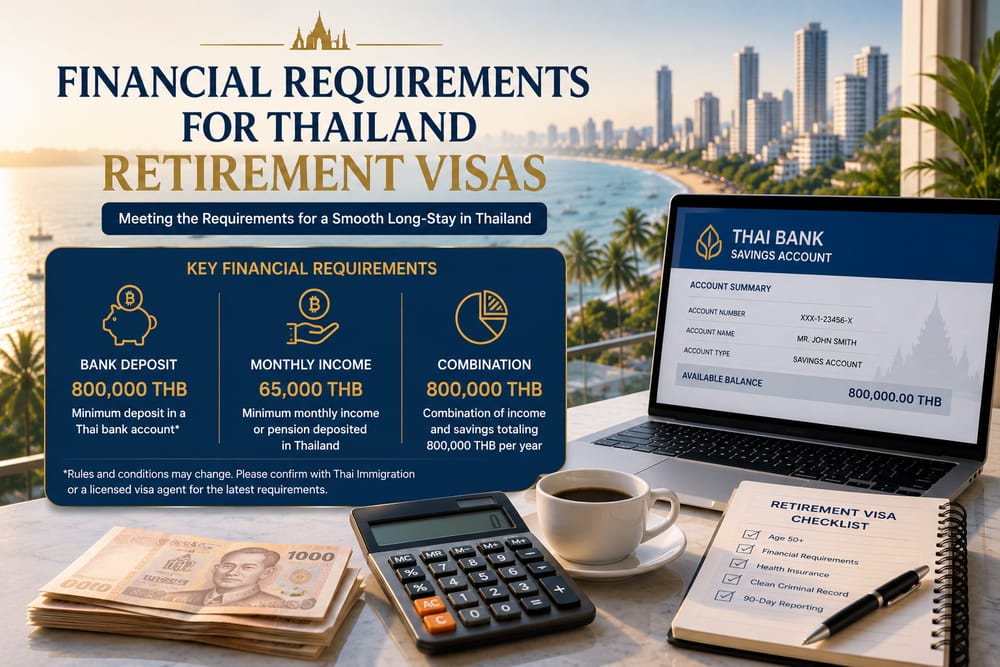
Age: Minimum 50 years old.
Financial requirement — one of the following three options:
A Thai bank deposit of at least 800,000 THB. Generally, this must be held in a Thai bank account for at least two months before application and maintained for at least three months after approval, after which balance rules may vary.
Requirements can differ and applicants should confirm current rules directly with Thai Immigration before applying.
Monthly income or pension of at least 65,000 THB transferred into Thailand
A combination of income and savings that totals 800,000 THB per year
Health insurance: Health insurance is generally required for Non-Immigrant O-A applications, but requirements may differ for Non-O retirement extensions. Confirm the exact requirement with the embassy, immigration office, or visa lawyer before applying.
Current official guidance is published at longstay.tgia.org, the Thailand Insurance Commission's official long-stay insurance portal.
Criminal record: A clean background check from your home country is required for the initial application.
90-day reporting: Throughout your stay, you must report your address to Thai immigration every 90 days. This can often be done online or through a visa agent.
Retirement-based O-A visas and retirement extensions generally allow a 12-month stay, subject to meeting renewal and reporting requirements.
The visa places no restriction on where in Thailand you live. Multiple re-entries are possible with a re-entry permit, which you purchase separately.
The Retirement Visa does not grant permanent residency, a path to citizenship, or any right to work in Thailand. Employment requires a separate work permit regardless of visa type.
The 800,000 THB bank deposit requirement also means that capital sits idle in a Thai bank account throughout your stay, which can be a meaningful trade-off depending on your financial situation.
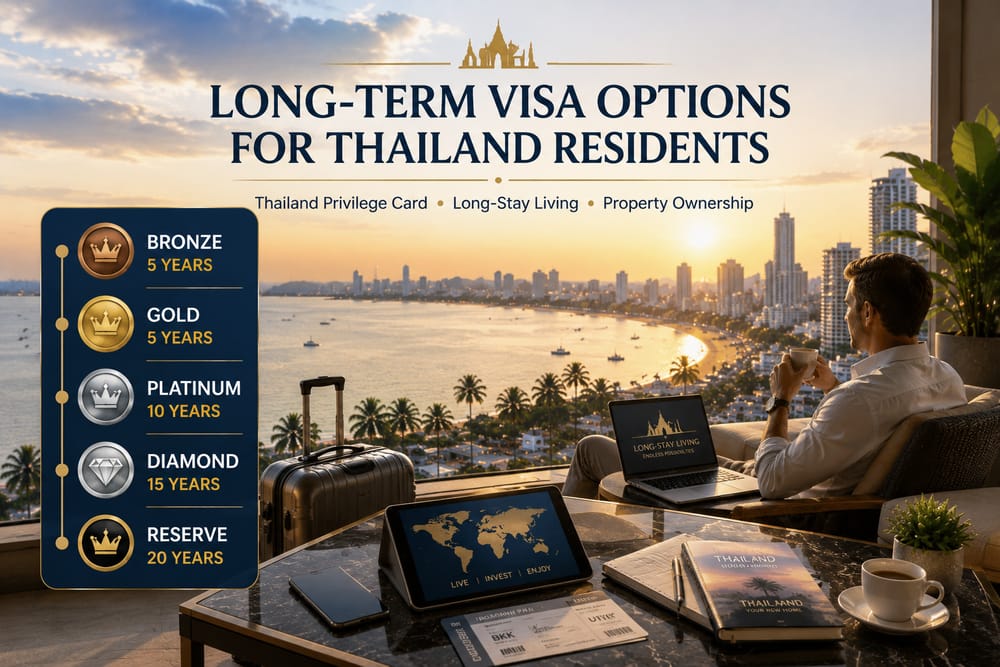
The Thailand Privilege Card — still widely referred to as the Thailand Elite Visa — is a paid membership programme operated by Thailand Privilege Card Co., Ltd., a subsidiary of the Tourism Authority of Thailand. It was rebranded from "Thailand Elite" to "Thailand Privilege" in October 2023, but the programme itself remains the same.
Unlike the Retirement Visa, it is not age-restricted and does not require proof of monthly income or a Thai bank deposit. Instead, it is purchased as a long-term membership at a one-time government fee, granting multiple-entry long-stay visas ranging from 5 to 20 years depending on the tier.
As of 2026, there are five official tiers:
Bronze — 5-year membership. This is a promotional entry-level tier at the lowest price point in the programme. As availability and promotional deadlines can change, confirm whether this tier is still open before applying.
Gold — 5-year membership. The standard 5-year tier with a higher points allocation than Bronze.
Platinum — 10-year membership. The most popular mid-range tier for buyers planning a decade or more in Thailand.
Diamond — 15-year membership. For buyers seeking a longer commitment with enhanced privileges.
Reserve — 20-year membership. The highest tier, typically treated as invitation-only. Eligibility and availability are controlled by Thailand Privilege Card Co., Ltd.
For current pricing across all tiers, visit thailandprivilege.com — the official government website for the programme.
Prices are set by Thailand Privilege Card Co., Ltd. and do not vary between licensed agents.
Membership structures and pricing can change; always verify directly with Thailand Privilege before making any financial decisions.
The Privilege Card grants a long-stay multiple-entry visa for the full membership duration, with no annual immigration renewal appointments required.
There is no income proof required, no Thai bank balance to maintain, and no age minimum. Additional benefits include VIP airport fast-track services at major Thai airports, government liaison and concierge support, and a points system redeemable for certain services.
Like the Retirement Visa, it grants no work rights and does not lead to permanent residency or citizenship.
The 90-day reporting obligation to Thai immigration remains in full regardless of which visa type you hold. The upfront cost is significant, and the membership is not transferable if your circumstances change.
One important note for buyers who plan to spend more than 180 days per year in Thailand: staying that long makes you a Thai tax resident.
Under Thailand's updated foreign income remittance rules introduced in 2024, overseas income transferred into Thailand may be assessable for Thai personal income tax regardless of which visa you hold.
This applies to Privilege Card holders and Retirement Visa holders equally.
A qualified Thai tax advisor separate from your visa agent can help you understand the implications for your specific financial situation before you commit to living here long-term.
Before going deeper into which suits your situation, here is a direct comparison of the two main options across the factors that matter most to Pattaya property buyers.
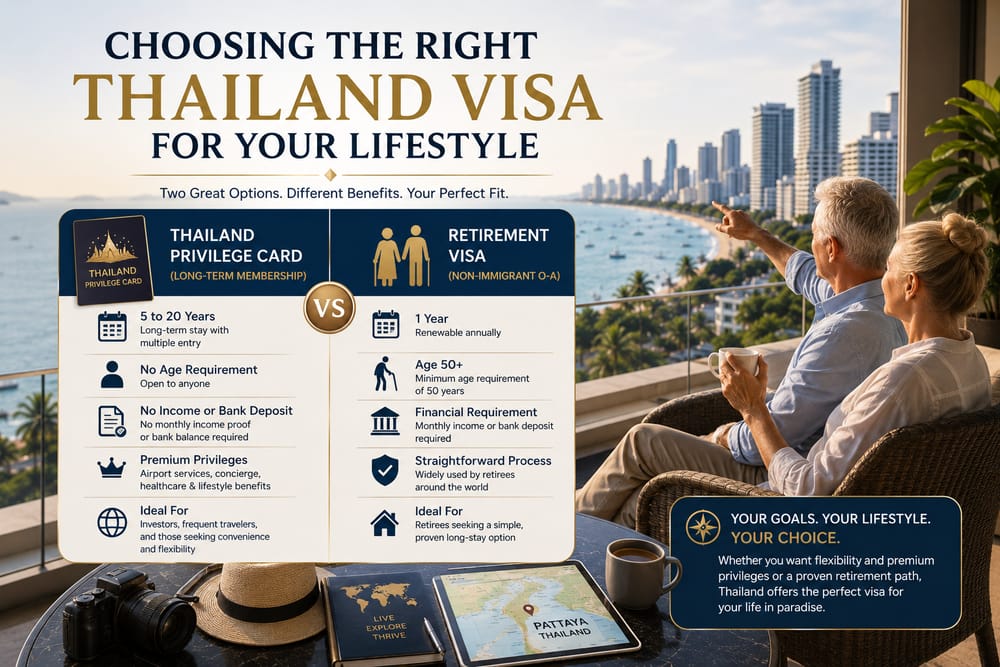
Minimum age: The Retirement Visa requires you to be 50 or older. The Thailand Privilege Card has no age requirement.
Thai bank deposit: The Retirement Visa requires 800,000 THB held in a Thai bank account (or equivalent income). The Thailand Privilege Card requires none.
Income proof: The Retirement Visa requires documented income or savings evidence. The Thailand Privilege Card requires none.
Upfront cost: The Retirement Visa has no membership fee — only small admin and agent costs each year. The Thailand Privilege Card requires a significant one-time government membership fee.
Visit thailandprivilege.com for current pricing.
Visa length: The Retirement Visa is valid for one year and must be renewed annually. The Thailand Privilege Card covers 5 to 20 years depending on the tier selected.
Annual renewal required: Yes for the Retirement Visa. No for the Thailand Privilege Card.
Airport VIP benefits: Not included with the Retirement Visa. Included with the Thailand Privilege Card.
Work rights: Neither visa permits employment in Thailand without a separate work permit.
Best suited for: The Retirement Visa suits retirees aged 50 or older with a stable pension or savings who are comfortable with an annual renewal process.
The Thailand Privilege Card suits younger buyers, frequent international travellers, and those who prefer long-term visa certainty without tying up capital in a Thai bank account.
There is no universally correct answer. The right choice depends on your age, financial situation, how much time you plan to spend in Thailand, and how much administrative friction you are willing to manage each year.
You are 50 or older and have a reliable pension or stable savings that can comfortably cover the 800,000 THB deposit requirement without meaningfully affecting your daily finances.
If you are happy to renew annually and engage with Thai immigration each year which many Pattaya-based visa agents handle for a modest annual fee — the Retirement Visa remains one of the most practical and cost-effective long-stay options in the world for retirees.
It suits the classic expat retiree profile very well. Most long-term foreign residents in Pattaya who retired here five to fifteen years ago are on exactly this visa.
You are under 50 and the Retirement Visa is therefore not available to you. Or you travel frequently between Thailand and other countries and value flexibility without annual immigration paperwork. Or you do not want 800,000 THB tied up in a Thai bank account and prefer your capital working elsewhere.
The Privilege Card has also become increasingly popular among buyers purchasing a Pattaya property as a second home or seasonal base rather than a permanent full-time residence — the multi-year visa structure removes annual renewal risk and simplifies the ownership experience significantly.
Buyers who are considering new projects and want to understand what is being built in Pattaya right now can explore current new developments alongside their visa planning.
In practice, Pattaya's long-stay foreign community skews toward the Retirement Visa simply because of demographics.
The majority of long-stay buyers in Pattaya are over 50, and the cumulative annual cost of maintaining the Retirement Visa is far lower than the Privilege Card's upfront fee for buyers who do not intend to stay for a decade or more.
However, the profile is shifting. As Pattaya attracts younger international buyers from the Middle East, Russia, China, and various European markets, the Thailand Privilege Card is increasingly selected because it removes age and income requirements entirely and provides long-term visa certainty in a single upfront decision.
For second-home buyers who plan to spend two to four months per year in Pattaya while travelling internationally for the remainder, the Privilege Card's multiple-entry structure and significantly reduced administrative burden often makes more practical sense than managing an annual Retirement Visa renewal from overseas.
Not directly. Both visa types allow foreigners to legally purchase and own condominium units in Thailand under the foreign freehold quota system — foreigners may collectively own up to 49% of the total saleable floor area of a registered condominium building.
For a full breakdown of what foreigners can and cannot own in Thailand, our guide on can foreigners buy property in Pattaya covers ownership structures, legal options, and common questions in detail.
Neither visa grants land ownership rights, which are governed separately by Thai property law regardless of which visa you hold.
Where visa choice does intersect with your property decision is in two specific areas.
Thai bank account requirements. If you choose the Retirement Visa, you will need to maintain 800,000 THB in a Thai bank account and demonstrate this at annual renewal.
This means establishing a Thai bank account as part of your overall setup — which is also required for the Foreign Exchange Transaction (FET) form needed to transfer purchase funds into Thailand when buying property.
Long-term certainty. Buying property in Pattaya is a long-term commitment. If your visa situation requires annual renewal with documentation risk attached, that can affect your peace of mind as an owner.
Some buyers, particularly those purchasing higher-value properties or planning to spend significant time in Pattaya — choose the Privilege Card specifically to remove that annual uncertainty from their lives here.
For a detailed walkthrough of how the purchase process works, our guide on how to buy a condo in Thailand as a foreigner covers foreign quota, FET requirements, contracts, and transfer procedures step by step.
Our guide on the real buying costs of a condo in Pattaya is also useful for understanding the full financial picture before you commit.
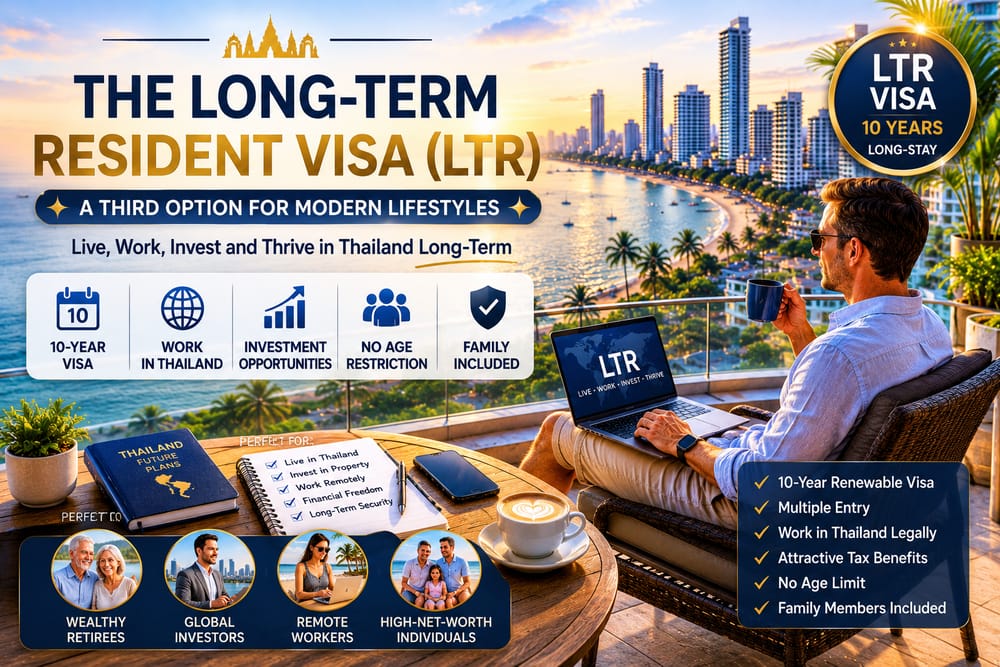
For completeness, a third long-stay visa introduced in 2022 is gaining awareness among higher-net-worth buyers: the Long-Term Resident (LTR) Visa, administered by Thailand's Board of Investment (BOI).
The LTR Visa offers a 10-year renewable visa (structured as two consecutive 5-year terms), reduced immigration reporting of once per year rather than every 90 days, and for certain categories, a flat 17% personal income tax rate and work authorisation through a digital work permit.
Wealthy Global Citizens are high-net-worth individuals with total global assets of at least USD 1 million, of which at least USD 500,000 must be invested in Thai assets such as government bonds, real estate, or BOI-approved investments. Following a rule change in February 2025, the previous USD 80,000 annual income requirement for this category was removed entirely.
Wealthy Pensioners are retirees aged 50 or older with passive annual income (pension, dividends, rental income, interest — employment income does not qualify) of at least USD 80,000. Alternatively, an income of at least USD 40,000 combined with at least USD 250,000 invested in qualifying Thai assets also satisfies this category.
Work-from-Thailand Professionals are remote workers employed by well-established overseas companies with annual income of at least USD 80,000.
Highly Skilled Professionals are experts working in targeted industries designated by the BOI, with income of at least USD 80,000.
The government application fee is 50,000 THB per person. The LTR Visa also includes a notable tax consideration: certain LTR holders particularly Wealthy Global Citizens and Wealthy Pensioners may qualify for exemptions on foreign-sourced income remitted to Thailand, subject to current BOI and Revenue Department regulations.
This is a meaningful advantage given Thailand's 2024 foreign income remittance tax rules, but the specific application should always be confirmed with a qualified Thai tax advisor.
For high-net-worth retirees or buyers who plan to remit significant income into Thailand, the LTR Visa deserves serious consideration alongside the Privilege Card and Retirement Visa.
It is more demanding to qualify for, but the combination of the 10-year term, reduced reporting, and tax benefits makes it attractive for the right profile.
Before engaging a visa agent or lawyer, ask yourself these questions honestly.
Am I 50 or older? If no, the Retirement Visa is not available. Consider the Thailand Privilege Card or LTR Visa.
Do I have 800,000 THB available to keep in a Thai bank account without it affecting my lifestyle?
If no, the Retirement Visa's deposit requirement is a real friction point. The Privilege Card removes this entirely.
How much time per year will I spend in Thailand?
If you plan to spend most of the year here, either visa works practically. If you travel constantly and want seamless multiple re-entries without annual administration, the Privilege Card's structure suits you better.
How do I feel about annual immigration renewals?
If this feels like an acceptable part of living in Thailand and many Pattaya residents genuinely do not find it burdensome with a good agent — the Retirement Visa works well. If you want minimal bureaucratic contact and visa certainty for a decade, the Privilege Card addresses this directly.
What is my 10-year horizon?
If you plan to be in Thailand for the long term, the Platinum Privilege Card's one-time cost may represent better overall value than a decade of annual Retirement Visa costs and agent fees combined. Run the numbers for your specific situation.
Once you have a clear picture, always consult a qualified Thai immigration lawyer or licensed visa agent. Requirements change, and the consequences of getting visa compliance wrong — fines, overstay records, and bans on re-entry — are serious.
Some foreign residents in Pattaya try to manage long-term stays through repeated tourist visas or visa exemptions. This approach is not recommended for property owners or long-stay residents.
Thai immigration increasingly scrutinises frequent border crossings without a proper long-stay visa. If you are buying property in Pattaya with the intention of staying regularly, a proper long-stay visa is the right foundation from the start.
If you are still in the research phase and not yet ready to buy, our properties for rent in Pattaya listings are worth exploring as a way to experience living in different neighbourhoods before committing to a purchase.

The most common mistake foreign buyers make in Pattaya is focusing entirely on the property decision before resolving the visa question. The two are closely connected. How you plan to stay legally in Thailand should shape your overall financial planning, your Thai bank account setup, and your long-term approach to living here.
If you are over 50 with a stable pension and comfortable savings, the Retirement Visa remains one of the most practical long-stay arrangements in the world for retirees — widely understood, well-supported by local agents, and deeply embedded in Pattaya's expat infrastructure.
If you are younger, internationally mobile, or simply prefer the clarity of a decade-long visa without annual paperwork, the Thailand Privilege Card is a genuinely strong alternative — and its cost, spread over ten or twenty years of Pattaya living, often looks reasonable in context.
Get your visa strategy right before you sign. It makes everything that comes after far simpler.
To start exploring what is available, browse all properties for sale in Pattaya or view the latest new developments to understand the current market before committing.
PropertySpace is a licensed real estate agency based in Pattaya, specialising in condos, houses, pool villas, and new developments across Jomtien, Wongamat, Pratumnak, East Pattaya, and Central Pattaya. For property enquiries, contact our team or browse current listings.
For visa decisions, always consult a qualified Thai immigration lawyer or licensed visa agent. This article is for general information only and does not constitute legal or immigration advice.
The Thailand Elite Visa — now officially called the Thailand Privilege Card — is a paid government membership programme granting a long-stay visa for 5 to 20 years with no income requirement, no Thai bank deposit, and no age restriction. It is a one-time fee paid to the Thai government; current pricing across all five tiers is published at thailandprivilege.com. The Retirement Visa is a free annual visa for foreigners aged 50 or older that requires either 800,000 THB maintained in a Thai bank account or proof of at least 65,000 THB in monthly income. It must be renewed every year at a Thai immigration office.
Yes. Foreigners under 50 cannot apply for the Retirement Visa, but the Thailand Privilege Card has no age restriction, making it one of the most accessible long-stay options for younger buyers. The LTR Visa is also available to qualifying individuals regardless of age. Both options allow multi-year stays in Thailand for property owners who do not meet the age threshold for the Retirement Visa.
No. You can legally purchase a condominium in Pattaya while on a tourist visa or visa exemption. Property ownership and visa status are legally separate in Thailand. However, if you intend to live in or regularly use your property for extended periods, a proper long-stay visa is strongly recommended to avoid immigration complications.
It depends on your situation. For buyers who plan to spend significant time in Thailand over ten or more years, the Platinum tier often becomes cost-competitive when compared with a decade of annual Retirement Visa costs, agent fees, and the opportunity cost of 800,000 THB locked in a Thai bank account. For buyers who will only spend a few months per year in Pattaya, the Retirement Visa if age-eligible may be more cost-effective. Check current Privilege Card pricing at thailandprivilege.com and run the numbers for your specific situation before deciding.
Your visa renewal will be at risk if you cannot demonstrate the required financial evidence. Thai immigration checks bank statements during the annual renewal process. If funds fall below the required threshold, renewal is likely to be refused. This ongoing requirement is one of the main reasons some long-stay residents prefer the Thailand Privilege Card, which has no ongoing financial balance requirement after the initial membership fee.
A spouse can apply for a Non-Immigrant O visa based on the primary holder's status, but this is a separate application with its own documentation requirements. For couples, the Thailand Privilege Card's family add-on arrangements where additional members can be included at an extra cost are sometimes simpler to manage. Confirm current family options directly with Thailand Privilege Card Co., Ltd. as policies and pricing for additional members have changed over the years.
The Long-Term Resident (LTR) Visa is a 10-year renewable government programme introduced in 2022 for high-net-worth individuals, wealthy pensioners, remote workers, and highly skilled professionals meeting specific income and asset thresholds. Unlike the Privilege Card, it is not a paid membership eligibility is based on verified income and assets. Certain LTR categories also permit working in Thailand through a digital work permit and provide an exemption on Thai income tax for foreign-sourced income, benefits that the Privilege Card does not include.
The majority of long-term foreign residents in Pattaya use the Retirement Visa because most long-stay buyers are aged 50 or older and the annual cost is considerably lower than the Privilege Card's upfront fee. However, the Privilege Card is growing in popularity among younger buyers, frequent international travellers, and those who prefer to avoid the 800,000 THB Thai bank deposit requirement.
Pattaya is consistently one of Thailand's most established retirement destinations, offering beachfront living, private international hospitals, a large English-speaking expat community, a wide range of property types across different price points, and strong regional transport connections via road to Bangkok and U-Tapao International Airport to the south. For a detailed breakdown of where retirees tend to settle, our guide to the best areas to live and buy property in Pattaya covers Jomtien, Pratumnak Hill, Wongamat, and East Pattaya with neighbourhood-level insight.
Yes, and many long-stay residents do. Pattaya has a well-established network of licensed visa agents who handle the annual Retirement Visa renewal process including document preparation and immigration office attendance. Fees vary between agents ask for a quote from a locally recommended agent before committing. This is a standard and widely used service among Pattaya's foreign community, making the annual renewal far less burdensome in practice than it might appear from the outside.
No. The Thailand Privilege Card does not provide any special property ownership rights. Foreigners buying condominiums in Thailand remain subject to the same ownership laws and foreign quota restrictions regardless of whether they hold a Thailand Privilege Card, Retirement Visa, LTR Visa, tourist visa, or visa exemption. The 49% foreign freehold quota applies to all foreign buyers equally specifically, foreigners may collectively own up to 49% of the total saleable floor area of a registered condominium building and land ownership restrictions apply to all foreigners equally, regardless of visa type. Your visa gives you the right to stay in Thailand it does not change what you are legally permitted to own.

Jeremy
Real Estate Agent
Avoiding Rental Scams in Pattaya: What to Look Out for When Renting (2026 Guide)
Learn what to look out for when renting in Pattaya in 2026, including common rental scams, agent risks, and contract mistakes to avoid.
Best Areas to Buy a House in Pattaya 2025 | PropertySpace Pattaya Guide
Discover the best areas to buy a house in Pattaya in 2025, from family-friendly neighborhoods to premium villa zones.

Best Areas to Live & Buy Property in Pattaya — PropertySpace Neighborhood Guide
Looking for the best areas to live or buy property in Pattaya? Discover lifestyle insights, expat favorites, and expert guidance from PropertySpace.
Best Modern Condos in Jomtien (2026 Guide for Foreign Buyers)
A practical 2026 guide to the best modern condos in Jomtien for foreign buyers and expats, featuring beachfront, lifestyle, and long-stay condominium options.

Best Pattaya Properties for Sale: Condos, Houses & Villas
Explore the best Pattaya properties for sale, including condos, houses, pool villas, top areas, prices, and buying tips for foreign buyers.

Best Real Estate Agency in Pattaya 2025 | PropertySpace Guide
Discover how to find the best real estate agency in Pattaya. Expert tips and trusted local insight from PropertySpace Pattaya.

Buying a Condo or Villa in Pattaya: The Ultimate Guide for Expats
Navigating the legal landscape is essential when buying property in Pattaya as an expat.

Can Foreigners Buy Property in Pattaya? A Comprehensive Guide
Understanding Property Ownership for Foreigners in Thailand

Discover the Luxurious Lifestyle at Zenith Pattaya: A Wellness-Centered Paradise
Pattaya's First Wellness-Centered Living Experience

Highgate International School Pattaya | Property Investment Guide
Discover how Highgate International School Thailand boosts Pattaya’s real estate market and property investment opportunities.
How to Buy a Condo in Thailand as a Foreigner: Step-by-Step Process (2026 Guide)
A practical 2026 guide for foreigners buying a condo in Thailand, covering foreign quota, FET, costs, contracts, and transfer steps clearly.
How to Rent Out Property in Pattaya: 2026 Landlord Guide
Learn how to rent out property in Pattaya as a foreign owner, including TM30, tenant screening, rental pricing, tax and property management.
How to Sell a Condo in Pattaya as a Foreign Owner
A practical guide for foreign condo owners in Pattaya covering resale pricing, documents, taxes, transfer fees and sending sale proceeds overseas.
International Schools in Pattaya: Complete Guide for Expat Families
Explore international schools in Pattaya, curriculum options, fees structure and best areas for expat families relocating to Thailand.
Leasehold vs Freehold in Pattaya: What Foreign Buyers Should Actually Know Before Buying
Understand leasehold vs freehold in Pattaya for foreign buyers. Learn the real differences, legal risks, resale impact, and which ownership type may suit your goals.

Luxury Coastal Living at Aquarous Jomtien Condominium, Pattaya
Discover Aquarous Jomtien Condominium, a stunning high-rise development in Jomtien Pattaya, offering breathtaking 85% sea-view units, world-class amenities, and luxurious living spaces.

Off-Plan Condos in Pattaya: A Wise Investment or a Risky Bet?
This article aims to guide you through the ins and outs of investing in off-plan condos in Pattaya.

Pattaya Smart City: How AI CCTV Is Making Pattaya a Safer Place to Live, Visit, and Invest
Pattaya Smart City is transforming Pattaya through AI CCTV, Pattaya Connect, and smarter public safety systems, helping create a safer city for residents, tourists, and property investors in 2026.

Property Inspection Pattaya: What Buyers Should Really Check Before Taking Ownership (2026)
Learn what buyers should really check during a property inspection in Pattaya, including common issues, timing, and new vs resale considerations.
Rental Agreement Thailand: What Pattaya Tenants Should Check Before Signing
Understand rental agreements in Pattaya, including deposits, lease terms, utilities, repairs and what tenants should check before signing.
Renting in Pattaya: What to Know Before You Rent
Everything you need to know about renting a condo, house, or pool villa in Pattaya — best areas, costs, documents, and what your rental agent actually does.

The Riviera Beverly Hills Residence: Pattaya’s New Luxury Condo Investment Opportunity
Discover The Riviera Beverly Hills Residence, a luxury low-rise condo in Jomtien. Perfect for investors, expats & families seeking a Pattaya property.

The Riviera California - Iconic Living For The Few
Luxury Sea View Condos in Pattaya with 5-Star Concierge & Iconic Rooftop Pools | 122 Residences Only

The Riviera Santa Monica: Luxury Living Meets California Vibes in Jomtien, Pattaya
Discover The Riviera Santa Monica, an extraordinary 7th high-rise condominium by the award-winning Riviera Group.

Top 5 Condos in Pattaya 2025 | Best New Projects & Investment Guide
Discover Pattaya’s top 5 condo projects for 2025 — verified developments, investment potential, and local insight from PropertySpace.

Top Luxury Villas in Pattaya 2025 | PropertySpace Pattaya Guide
Explore Pattaya’s top luxury villa estates and pool villas in 2025 — gated communities, prime areas, and trusted insights from PropertySpace Pattaya

What Are the Real Buying Costs of a Condo in Pattaya?
Understand the real buying costs of a condo in Pattaya, including transfer fees, maintenance fees, sinking fund, legal checks, and hidden costs buyers often miss.

Where to Buy a House in Pattaya as a Foreigner (2026 Practical Guide)
A practical 2026 guide for foreigners buying houses in Pattaya, covering the best areas, ownership options, and real-life buying considerations.

Why Pattaya Attracts Long-Stay Residents, Retirees and Second-Home Owners in Thailand
Discover why Pattaya attracts long-stay residents, retirees, and second-home owners seeking coastal living, convenience, and lifestyle flexibility

Why Pattaya is the Ideal Destination for Retirement
Discover why Pattaya is the ideal place to retire in Thailand

Why Pattaya Property Looks Stronger in 2026: EEC Growth, 3 Million Baht Condo Rules, and What Foreign Buyers Should Know
Pattaya property in 2026 is being shaped by EEC growth, stronger infrastructure, Aquatique District, and the 3 million baht condo extension support route. This guide explains what foreign buyers should understand before investing.

089 714 1551 (ENG/TH)
Call Now081 969 4950 (ENG/CN)
Call Now