
Author: Jom
Published on: 2026-07-01
Moving to Pattaya and want to rent a condo, house, or pool villa? Before you start, it's worth browsing the latest Properties for Rent in Pattaya to understand current prices and what's available across different areas.
This guide covers the best areas to rent in, how the process works, what things cost, what documents you need, and what your rental agent will and won't do for you. It also covers the small problems that are simply normal when you live in a real home instead of a hotel. Read this before you sign anything.
This guide covers renting as a tenant. If you're a property owner looking to rent out your unit instead, see our landlord's guide to renting out property in Pattaya.
Renting in Pattaya means finding a condo, house, or pool villa, viewing it in person, paying a deposit plus one month's rent, and signing a lease. Most residential rentals last 6 to 12 months. All you legally need as a foreigner is a valid passport.
A rental agent helps you find the property, check the paperwork, and record the unit's condition at move-in. Day-to-day cleaning and small issues like light bulbs are the tenant's job. Bigger repairs go through the landlord, with the agent helping to coordinate.
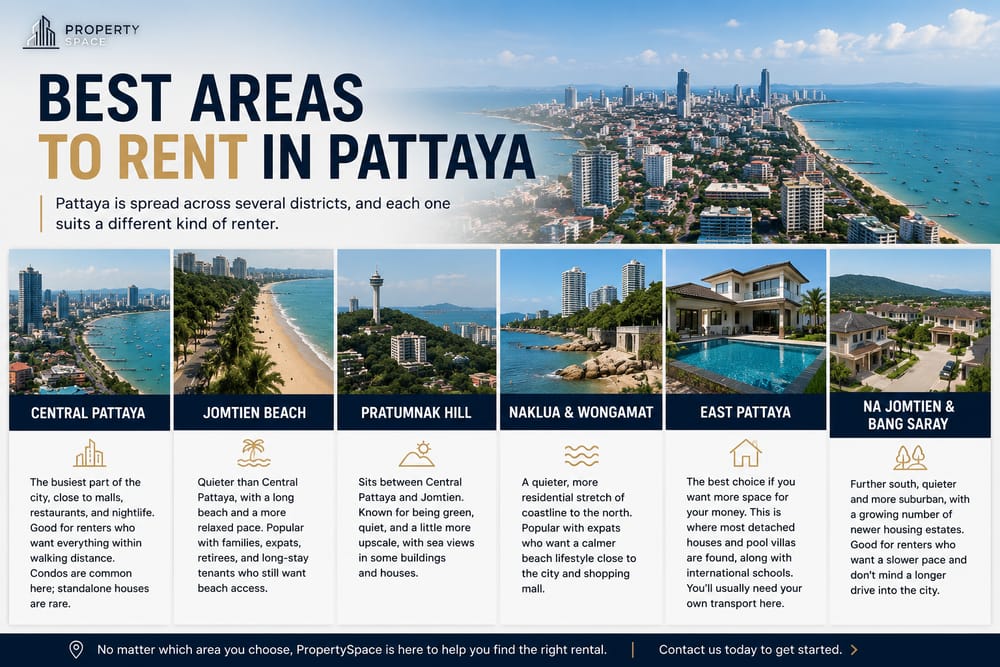
Pattaya is spread across several districts, and each one suits a different kind of renter. Here's a quick breakdown to help you narrow down where to look.
Central Pattaya: The busiest part of the city, close to malls, walking street, restaurants, and nightlife. Good for renters who want everything within walking distance. Condos are common here
Jomtien Beach: Quieter than Central Pattaya, with a long beach and a more relaxed pace. Popular with families, expats, retirees, and long-stay tenants who still want beach access.
Pratumnak Hill: Sits between Central Pattaya and Jomtien. Known for being green, quiet, and a little more upscale, with sea views in some buildings and houses.
Naklua and Wongamat: A quieter, more residential stretch of coastline to the north. Popular with expats who want a calmer beach lifestyle close to the city and Terminal 21 shopping mall.
East Pattaya: The best choice if you want more space for your money. This is where most detached houses and pool villas are found, along with international schools. You'll usually need your own transport here.
Na Jomtien and Bang Saray: Further south, quieter and more suburban, with a growing number of newer housing estates. Good for renters who want a slower pace and don't mind a longer drive into the city.
If you're not sure which area fits your lifestyle, it helps to view a few properties across two or three neighborhoods before deciding, rather than committing to the first one you see.
If you're still deciding, browsing Best area to live and buy property in Pattaya can help you compare different neighbourhoods, budgets, and property types before arranging viewings.
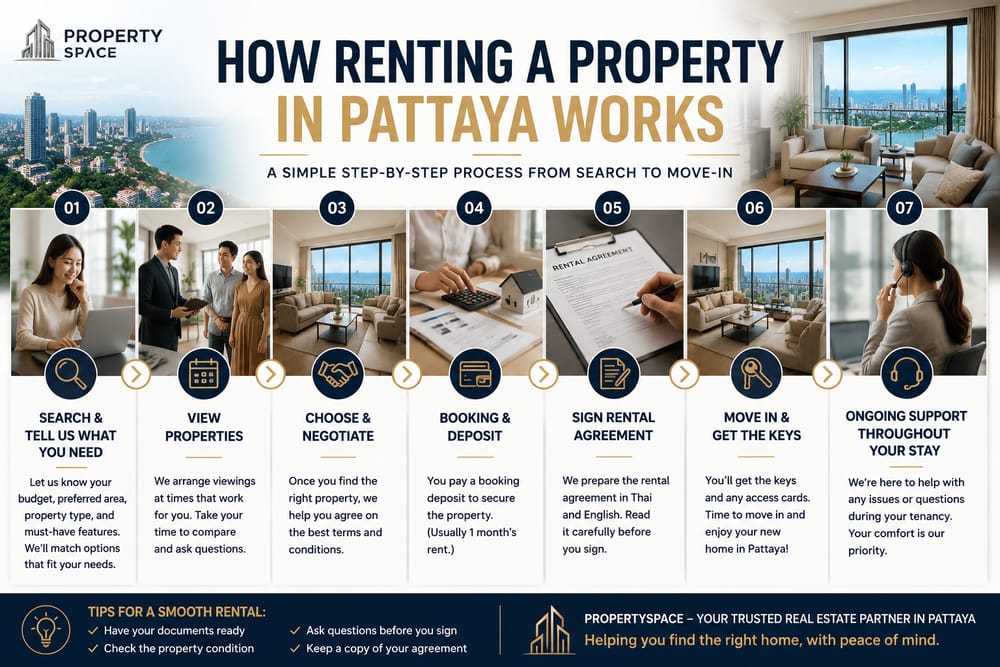
Renting in Pattaya follows a simple path. Here is what usually happens, step by step.
- You tell an agent what you need. Budget, area, and property type (condo, house, or pool villa).
- The agent sends you a shortlist. You pick a few to view in person. If you prefer to browse first, you can explore the latest condos for rent in Pattaya, houses for rent, or pool villas for rent before contacting an agent.
- You view the units. Never skip this step, even if photos look perfect. During the viewing, it's worth checking: water pressure in the taps and shower, how old and how noisy the aircon units sound, the condition of appliances, any signs of pests, mobile and internet signal, parking space, and the noise level of the area.
- You agree on price and terms. Some landlords accept a small discount depending on the property price and conditions.
- You may be asked for a booking fee to hold the unit. This is usually equal to one month's rent and is used to reserve the property while paperwork is prepared. It normally counts toward your first month's rent once you sign. If you decide not to go ahead after paying it, you will usually lose this fee, since the landlord has taken the property off the market for you.
- You pay the remaining deposit and sign the contract. Usually one to two months' rent as deposit, plus the first month's rent.
- You move in. The agent walks through the unit with you, records its condition, and notes down the electricity and water meter readings before you get the keys.
Most residential leases in Pattaya are for 6 or 12 months. Shorter leases are possible but usually cost more per month.
Renting as a foreigner in Pattaya is simpler than most people expect. There is no credit check system like in Western countries, and you don't need a work permit just to rent.
In most cases, you'll need:
- A valid passport. This is the one document every landlord will ask for, usually a copy of the photo page and your current visa or entry stamp page.
- Cash or bank transfer for the deposit and first month's rent. This is paid at signing, before you receive the keys.
- A contact number. So the landlord or agent can reach you during the tenancy.
Some landlords may also ask for proof of income or an employment letter, particularly for higher-end condos, houses, or pool villas, but this is the exception rather than the rule in Pattaya.
A tourist visa is generally enough to sign a lease, though landlords typically prefer tenants who can clearly show how long they intend to stay.
Certain landlords, especially for houses and pool villas, will specifically ask for a proper long-stay visa before agreeing to rent. This isn't about being difficult — it's usually their way of making sure the property is going to a genuine long-term resident rather than being used for short-term tourist stays, which they may worry could lead to more wear and tear on the home.
Prices varies by location / building quality / views / furnishings, but here is a general idea of what long-term renters can expect:
- Studio or 1-bed condo: around 8,000–20,000 THB per month
- 2-bed condo: around 22,000–40,000 THB per month
- House (2–3 bed): around 25,000–60,000 THB per month
- Pool villa: around 40,000–100,000+ THB per month
- Booking fee: usually one month's rent, paid to reserve the unit before signing
- Security deposit: usually 2 months' rent
- Electricity: billed by the Provincial Electricity Authority (PEA) based on usage. In privately managed estates or condos, always check whether you're billed at the official government rate or a marked-up estate rate, since the difference can be significant.
- Water: usually billed by the Provincial Waterworks Authority (PWA), or through the estate, and is normally much lower than your electricity bill
- Agent commission: paid by the landlord, not the tenant, in almost all cases
A good rule to remember: in Thailand, the landlord pays the agent's commission, not the tenant. If someone asks you, the tenant, to pay an agent fee on top of your deposit and rent, ask exactly what that fee is for before you pay it.
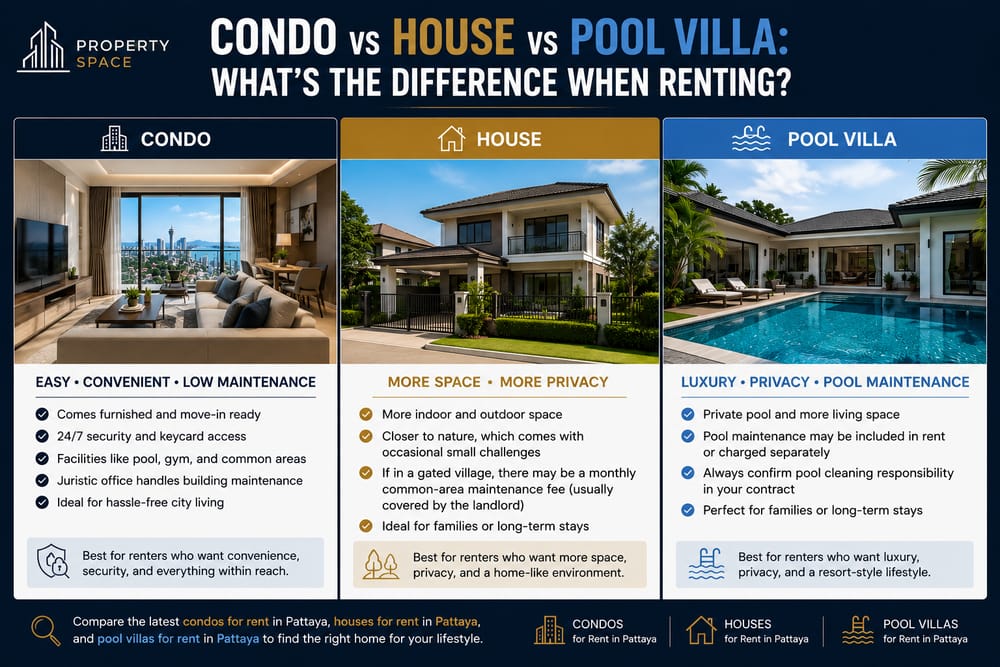
Condos are the easiest option for most renters. They come furnished, have building security, and the building itself (lifts, pool, gym, common areas) is maintained by the juristic office, not your landlord or agent.
Houses give you more space and privacy but usually mean you handle more of the garden and outdoor upkeep yourself, unless your lease says otherwise. Houses also sit closer to nature, which brings its own set of small challenges (more on this below). If the house sits inside a gated village or estate, there may be a monthly common-area maintenance fee, but this is usually the landlord's cost to cover, not yours, so it's worth confirming before you sign.
Pool villas add private pool maintenance to the mix. Some landlords include pool cleaning in the rent. Others don't. This should always be written clearly in your contract before you sign.
Before deciding, compare the latest condos for rent in Pattaya, houses for rent in Pattaya, and pool villas for rent in Pattaya to see how space, facilities, and pricing differ across each property type.
Most condos and houses for rent in Pattaya come fully furnished, including basic furniture, a bed, a fridge, a washing machine, and air conditioning. This is standard practice, unlike many Western rental markets where furniture is often extra.
That said, unfurnished units, particularly houses, are sometimes available at a lower monthly price, so it's worth confirming what's included before comparing listings.
If you have your own furniture you'd like to bring in, this is something to raise with the landlord before signing, not after moving in.
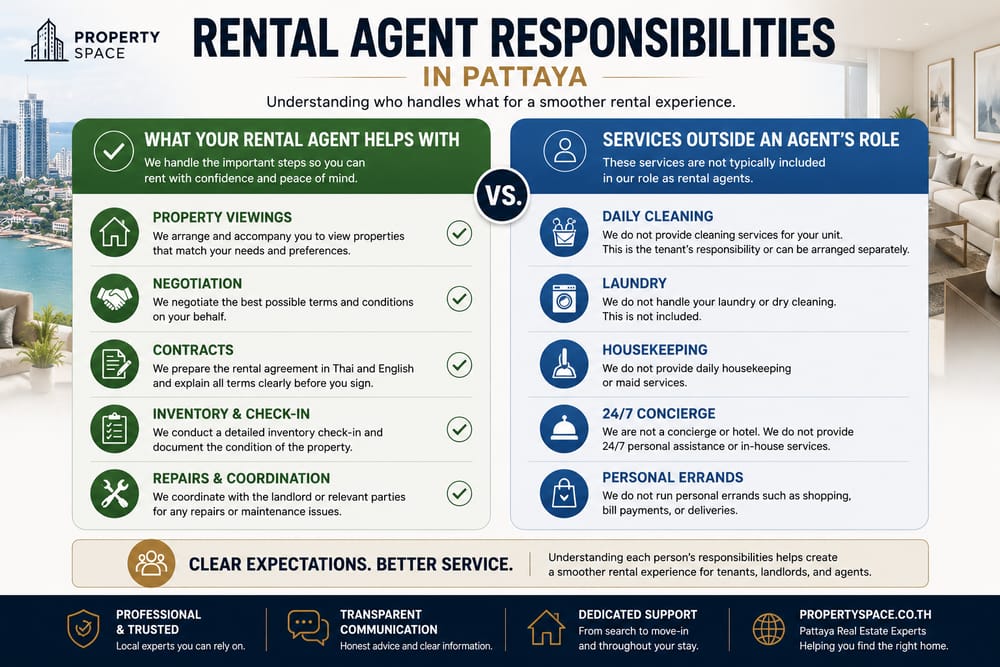
A good rental agent in Pattaya does real work for you before, during, and at the end of your lease.
Here is what falls under an agent's job:
- Showing you properties that match your budget and needs
- Checking that the person renting the unit to you actually has the right to rent it out
- Explaining lease terms in plain language
- Helping negotiate rent, deposit, and lease length
- Making sure the contract is clear on who pays what (rent, utilities, deposit conditions)
- Recording the inventory and condition of the property at check-in. This means writing down and photographing the state of furniture, appliances, walls, and fittings before you move in, along with the electricity and water meter readings. This protects you, because it proves any damage found later wasn't caused by you. It also protects the landlord for the same reason.
- Passing on maintenance requests to the landlord and coordinating with technicians when something needs fixing
- Being your point of contact if a genuine dispute comes up with the landlord
Experienced local agents also understand which buildings have stronger management, faster maintenance response, and better long-term tenant satisfaction — details that are difficult to judge from listings alone.
This is the job most tenants expect. But renters sometimes expect more than this, and that's where confusion starts.
If you're weighing up which agency to work with, our guide on choosing the best real estate agency in Pattaya covers what separates a reliable agent from the rest.
This is the part many first-time renters in Pattaya get wrong. An agent is not the same as a hotel concierge, a housekeeper, or a maintenance worker.
Once you have moved in, here is what is normally outside an agent's job:
- Daily or weekly cleaning of your unit. This is either your own job or something you arrange and pay for separately, like a cleaning service.
- Room service, laundry pickup, or errands. A rental property is not a hotel stay. An agent will not come collect your laundry or bring you food.
- Being available at any hour for small requests. If you lock yourself out or misplace a key late at night, this is not something an agent is required to fix immediately. For anything that isn't urgent, it's best to send a text and wait for a reply during normal hours rather than calling in the middle of the night.
- Being available every day after move-in. Once your lease is signed and you've moved in smoothly, the agent's main hands-on job is done. They will still help if a real problem comes up, but they are not on call for daily requests.
- Replacing furniture or appliances because you don't like the style. That's between you and the landlord, based on what the lease contract says.
A rented condo or house is a real, lived-in home, not a hotel room, so small issues will come up during your stay. This is completely normal, and it happens to almost every tenant sooner or later. Knowing what to expect, and how the process works, saves a lot of frustration.
Light bulbs and small fittings. These wear out over time just like anywhere else. Usually this is a quick, simple fix, and normally the tenant's own task.
Pests. Landed houses in Pattaya sit closer to gardens, drains, and open land, so insects and small pests are more common than in a high-rise condo. If this happens, report it to your agent, who can arrange pest control on your behalf.
Electrical issues. Wiring, sockets, or fittings can act up from time to time. Report it to your agent, who will pass it on to the landlord and coordinate with a technician to come check it.
Aircon leaking or needing a service. Air conditioning units need regular servicing, and leaks can happen even in well-maintained units. Most units benefit from a proper deep clean every four to six months, which usually costs a few hundred baht per unit and is often the tenant's responsibility to arrange, unless your contract says otherwise. This is a common and normal request, and one your agent can help schedule.
Some of these issues are simply impossible to spot during a viewing or move-in check, even if you and your agent are careful. A pest problem or a slow water leak, for example, may only appear weeks after you've settled in. This doesn't mean the property was misrepresented. It just means it's a real, lived-in home.
Manage your expectations. No rental property, anywhere, is completely free of issues. Most landlords and agents in Pattaya are willing to help fix genuine problems that are covered under your contract, but repairs take a bit of time. A technician needs to be scheduled, parts sometimes need to be ordered, and coordination between agent, landlord, and repair company doesn't happen instantly.
As long as the issue is being handled, this is a normal part of renting, not a sign that something has gone wrong.
Yes, though it's not always guaranteed, especially for well-priced properties in good condition. A few things that genuinely help your position:
Offer a 12-month lease instead of 6. Landlords are sometimes willing to lower the monthly rent slightly for this commitment. This doesn't scale up, though — locking in a 3 or 5-year contract isn't a reliable way to save money, since Pattaya rents tend to rise over time rather than stay fixed.
Ask for inclusions instead of a lower price. If the rent itself won't move, ask about including internet, gardening maintenance, or an aircon service instead.
Be polite and patient. In Thailand, a calm, respectful approach usually works better than a hard, aggressive negotiation style. Let your agent help present requests, since they can often phrase things more tactfully on your behalf.
Time your requests properly. Raise any conditions or repair requests as part of your original offer, not after you've already signed the lease.
TM30 is a Thai immigration requirement, not something optional. It requires your landlord to report your address to Thai Immigration after you move in, and again each time you re-enter Thailand from abroad while renting the same property. This is generally expected to be filed quickly after your arrival.
It's worth confirming with your landlord or agent that this will be handled, since it's the landlord's legal responsibility, not yours, though it can cause you problems with visa extensions later if it's skipped.
Always view the unit in person, or ask for a live video tour. Never send money based on photos alone.
Get everything in writing. Verbal promises about repairs, furniture, or pets mean nothing without proof.
Read your contract carefully before you sign. A fair, clear contract protects both you and the landlord. Don't sign blindly and then place blame later over something the contract already covered.
Check the move-in inventory report together with your agent. Confirm it matches what you see, and add anything missing before you sign off on it.
Ask who pays for what. Electricity, water, internet, and maintenance fees should be spelled out clearly in the contract.
Don't rush a deposit transfer. If someone is pushing you to pay quickly before you've seen the property, slow down.
Work with a known local agency, not just a random contact on Facebook or LINE. For a deeper look at common rental fraud patterns in the city, see our guide on avoiding rental scams in Pattaya.
Signing a lease without reading it carefully, in full, including the fine print on repairs and deposit refunds
Assuming a lower price online means a better deal — always check what's actually included
Forgetting to confirm the security deposit refund terms before move-in
Not asking whether electricity is billed at the government PEA rate or a marked-up estate rate
Not asking about TM30 reporting and whether your landlord will actually take care of it
Choosing an agent based on price alone instead of local reputation and experience
Expecting a rented home to have zero issues over a 6 or 12 month stay
Assuming renting is always cheaper long-term without comparing it to buying a condo or house in Pattaya if you're planning to stay for several years
Renting in Pattaya is straightforward once you understand the process and know what to expect from each side — you, the landlord, and the agent.
A good agent makes finding your home easier, documents its condition at check-in, and helps coordinate repairs when something comes up. But they are not a substitute for a cleaner, a maintenance team, or 24-hour room service.
Small issues like a burnt-out light bulb, an aircon service, or the odd pest are simply part of living in a real home rather than a hotel. Knowing this from day one leads to a smoother experience for everyone.
If renting turns out to be a stepping stone rather than a long-term plan, it's worth reading up on the buying side too.
Our guides on how to buy a condo in Thailand as a foreigner and what to check during a property inspection in Pattaya walk through what changes once you move from renting to owning.
If you're ready to start your search, browse our latest Properties for Rent in Pattaya, including condos, houses, and pool villas, or contact PropertySpace for personalised recommendations based on your lifestyle and budget.
Yes. Foreign nationals can legally rent condominiums, houses, and pool villas in Thailand under a standard lease agreement.
Most landlords in Pattaya ask for two months' rent as a security deposit, plus the first month's rent paid upfront. The exact amount depends on the landlord and the property, so always confirm this before you commit.
A booking fee is usually one month's rent paid to hold a property while the lease is prepared. It normally becomes your first month's rent once you sign. It's separate from the security deposit, which is paid on top of it at signing.
This depends on what's agreed in your contract, so always confirm the refund timeline in writing before you sign. Keeping move-in photos as proof of the property's original condition makes the process smoother when it's time to move out.
Reasonable deductions typically apply to actual damage beyond normal daily use, or unpaid utility bills, rather than ordinary signs of a property being lived in. Since practices vary between landlords, it's worth confirming what counts as damage under your specific contract before you sign.
The landlord pays the agent's commission in almost all standard rental deals. Tenants normally do not pay agent fees on top of rent and deposit.
It depends, but most properties are furnished. Condos and houses for rent in Pattaya are commonly offered fully furnished, including basic furniture, appliances, and air conditioning. Some landlords also offer unfurnished units at a lower monthly price, particularly for houses, so it's worth asking what's included before you compare prices. If you want to bring your own furniture, raise this with the landlord before signing.
Sometimes, but it's not guaranteed, and a longer lease doesn't automatically mean a lower price. A 12-month lease can sometimes get a small discount compared to a 6-month one, but locking in a multi-year contract, like 3 or 5 years, isn't a reliable way to save money, since rental prices in Pattaya tend to rise over time rather than stay fixed. Well-priced properties in good condition are the least likely to be negotiable at all. If the rent itself won't move, it's often easier to ask about including extras like internet or gardening instead.
No. Daily and routine cleaning is the tenant's responsibility. An agent's role covers finding the property, arranging the lease, recording the move-in condition, and coordinating repairs — not ongoing housekeeping.
Report it to your agent or landlord in writing as soon as possible. Repairs for normal wear and tear, like aircon servicing or electrical faults, are usually the landlord's responsibility, while damage you caused yourself is usually your own cost.
Not usually. Pests, minor electrical faults, and aircon servicing are common in lived-in homes, especially landed houses. As long as the landlord and agent are willing to help fix genuine issues under the contract, this is a normal part of renting, not a red flag.
This should be reserved for real emergencies. For anything that isn't urgent, such as a lost key or a minor issue, it's better to send a text and wait for a reply during normal hours.
No. Renting is separate from working, so a work permit is not required. There is also no credit check system for renters in Thailand the way there is in many Western countries. A passport and the funds for your deposit and first month's rent are usually all you need.
A condo comes with building security, shared facilities, and common-area upkeep handled by the building's juristic office. A house gives you more space and privacy but usually means you take care of the garden and any outdoor maintenance yourself, unless your lease states otherwise.
TM30 is a Thai immigration form that reports a foreign tenant's address after move-in and after each re-entry into Thailand. It's the landlord's legal responsibility to file it, though it's worth confirming with your agent that it's actually being done.
Most residential leases run for 6 or 12 months. Shorter leases are available but often come at a higher monthly rate.
This depends on what's written in your lease. Most contracts include an early termination clause specifying the notice period and any penalties, so this should always be checked and understood before you sign, not after you need to use it.

Jom
Sales Manager
Avoiding Rental Scams in Pattaya: What to Look Out for When Renting (2026 Guide)
Learn what to look out for when renting in Pattaya in 2026, including common rental scams, agent risks, and contract mistakes to avoid.

Best Areas to Buy a House in Pattaya 2025 | PropertySpace Pattaya Guide
Discover the best areas to buy a house in Pattaya in 2025, from family-friendly neighborhoods to premium villa zones.

Best Areas to Live & Buy Property in Pattaya — PropertySpace Neighborhood Guide
Looking for the best areas to live or buy property in Pattaya? Discover lifestyle insights, expat favorites, and expert guidance from PropertySpace.

Best Modern Condos in Jomtien (2026 Guide for Foreign Buyers)
A practical 2026 guide to the best modern condos in Jomtien for foreign buyers and expats, featuring beachfront, lifestyle, and long-stay condominium options.

Best Pattaya Properties for Sale: Condos, Houses & Villas
Explore the best Pattaya properties for sale, including condos, houses, pool villas, top areas, prices, and buying tips for foreign buyers.

Best Real Estate Agency in Pattaya 2025 | PropertySpace Guide
Discover how to find the best real estate agency in Pattaya. Expert tips and trusted local insight from PropertySpace Pattaya.

Buying a Condo or Villa in Pattaya: The Ultimate Guide for Expats
Navigating the legal landscape is essential when buying property in Pattaya as an expat.

Can Foreigners Buy Property in Pattaya? A Comprehensive Guide
Understanding Property Ownership for Foreigners in Thailand

Discover the Luxurious Lifestyle at Zenith Pattaya: A Wellness-Centered Paradise
Pattaya's First Wellness-Centered Living Experience

Highgate International School Pattaya | Property Investment Guide
Discover how Highgate International School Thailand boosts Pattaya’s real estate market and property investment opportunities.
How to Buy a Condo in Thailand as a Foreigner: Step-by-Step Process (2026 Guide)
A practical 2026 guide for foreigners buying a condo in Thailand, covering foreign quota, FET, costs, contracts, and transfer steps clearly.
How to Rent Out Property in Pattaya: 2026 Landlord Guide
Learn how to rent out property in Pattaya as a foreign owner, including TM30, tenant screening, rental pricing, tax and property management.

International Schools in Pattaya: Complete Guide for Expat Families
Explore international schools in Pattaya, curriculum options, fees structure and best areas for expat families relocating to Thailand.
Leasehold vs Freehold in Pattaya: What Foreign Buyers Should Actually Know Before Buying
Understand leasehold vs freehold in Pattaya for foreign buyers. Learn the real differences, legal risks, resale impact, and which ownership type may suit your goals.

Luxury Coastal Living at Aquarous Jomtien Condominium, Pattaya
Discover Aquarous Jomtien Condominium, a stunning high-rise development in Jomtien Pattaya, offering breathtaking 85% sea-view units, world-class amenities, and luxurious living spaces.

Off-Plan Condos in Pattaya: A Wise Investment or a Risky Bet?
This article aims to guide you through the ins and outs of investing in off-plan condos in Pattaya.

Pattaya Smart City: How AI CCTV Is Making Pattaya a Safer Place to Live, Visit, and Invest
Pattaya Smart City is transforming Pattaya through AI CCTV, Pattaya Connect, and smarter public safety systems, helping create a safer city for residents, tourists, and property investors in 2026.

Property Inspection Pattaya: What Buyers Should Really Check Before Taking Ownership (2026)
Learn what buyers should really check during a property inspection in Pattaya, including common issues, timing, and new vs resale considerations.
Rental Agreement Thailand: What Pattaya Tenants Should Check Before Signing
Understand rental agreements in Pattaya, including deposits, lease terms, utilities, repairs and what tenants should check before signing.

Thailand Elite Visa vs Retirement Visa: Which Is Right for Pattaya Property Buyers in 2026?
Thinking of buying property in Pattaya and staying long-term? This guide compares the Thailand Retirement Visa and the Thailand Privilege Card (Elite Visa) — covering costs, requirements, and which long-stay visa suits your lifestyle and budget in 2026.

The Riviera Beverly Hills Residence: Pattaya’s New Luxury Condo Investment Opportunity
Discover The Riviera Beverly Hills Residence, a luxury low-rise condo in Jomtien. Perfect for investors, expats & families seeking a Pattaya property.

The Riviera California - Iconic Living For The Few
Luxury Sea View Condos in Pattaya with 5-Star Concierge & Iconic Rooftop Pools | 122 Residences Only

The Riviera Santa Monica: Luxury Living Meets California Vibes in Jomtien, Pattaya
Discover The Riviera Santa Monica, an extraordinary 7th high-rise condominium by the award-winning Riviera Group.

Top 5 Condos in Pattaya 2025 | Best New Projects & Investment Guide
Discover Pattaya’s top 5 condo projects for 2025 — verified developments, investment potential, and local insight from PropertySpace.

Top Luxury Villas in Pattaya 2025 | PropertySpace Pattaya Guide
Explore Pattaya’s top luxury villa estates and pool villas in 2025 — gated communities, prime areas, and trusted insights from PropertySpace Pattaya

What Are the Real Buying Costs of a Condo in Pattaya?
Understand the real buying costs of a condo in Pattaya, including transfer fees, maintenance fees, sinking fund, legal checks, and hidden costs buyers often miss.

Where to Buy a House in Pattaya as a Foreigner (2026 Practical Guide)
A practical 2026 guide for foreigners buying houses in Pattaya, covering the best areas, ownership options, and real-life buying considerations.

Why Pattaya Attracts Long-Stay Residents, Retirees and Second-Home Owners in Thailand
Discover why Pattaya attracts long-stay residents, retirees, and second-home owners seeking coastal living, convenience, and lifestyle flexibility

Why Pattaya is the Ideal Destination for Retirement
Discover why Pattaya is the ideal place to retire in Thailand
Why Pattaya Property Looks Stronger in 2026: EEC Growth, 3 Million Baht Condo Rules, and What Foreign Buyers Should Know
Pattaya property in 2026 is being shaped by EEC growth, stronger infrastructure, Aquatique District, and the 3 million baht condo extension support route. This guide explains what foreign buyers should understand before investing.

089 714 1551 (ENG/TH)
Call Now081 969 4950 (ENG/CN)
Call Now